Waymo: Tech on the Go
Overview
Client: Waymo
Agency: Cognition
Timeline: 2025 - 2026
Project Description
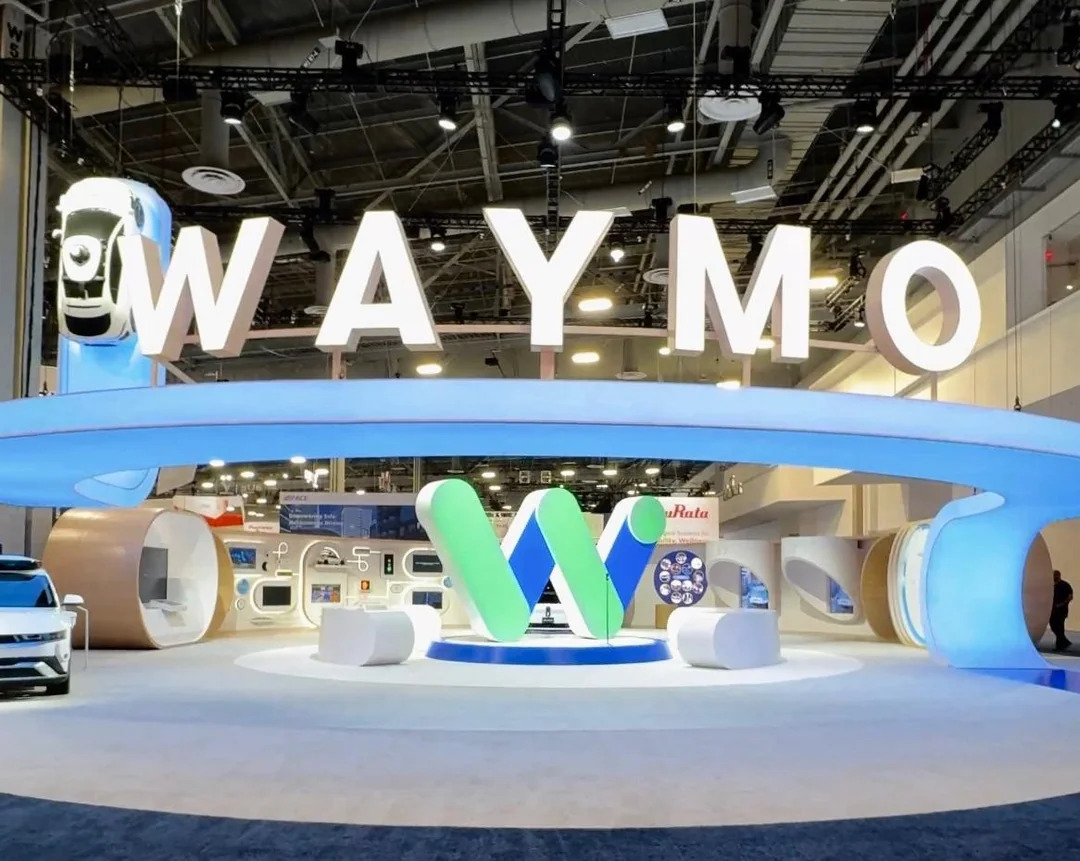
Waymo, the leader in autonomous vehicle technology, needed a breakthrough presence at CES 2025 to demonstrate their technical superiority in a landscape saturated with conceptual visions of the future. While competitors showcased distant promises, Waymo wanted to educate attendees on the real, operational technology powering their driverless vehicles today.
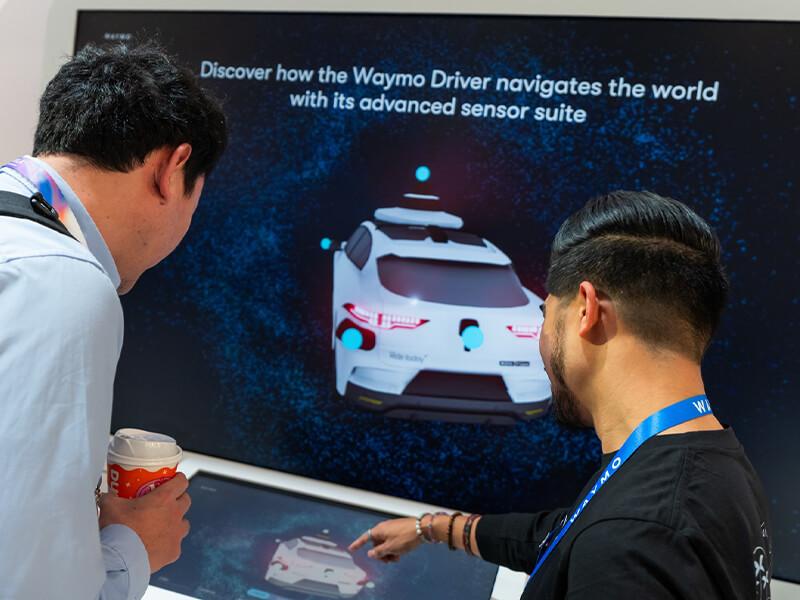
I developed Tech on the Go—an interactive 3D educational platform deployed on traveling kiosk touchscreens at events and trade shows. The application transforms complex autonomous driving systems into an accessible, engaging learning experience. Guests can explore fully interactive 3D Waymo vehicles, examining the sensor suite that enables the cars to perceive, interpret, and navigate their surroundings safely.
The platform serves as both an educational tool and a compelling demonstration of Waymo's engineering excellence, allowing visitors to understand the sophisticated integration of LiDAR, radar, cameras, and AI decision-making systems that make autonomous driving possible.
Guest Experience
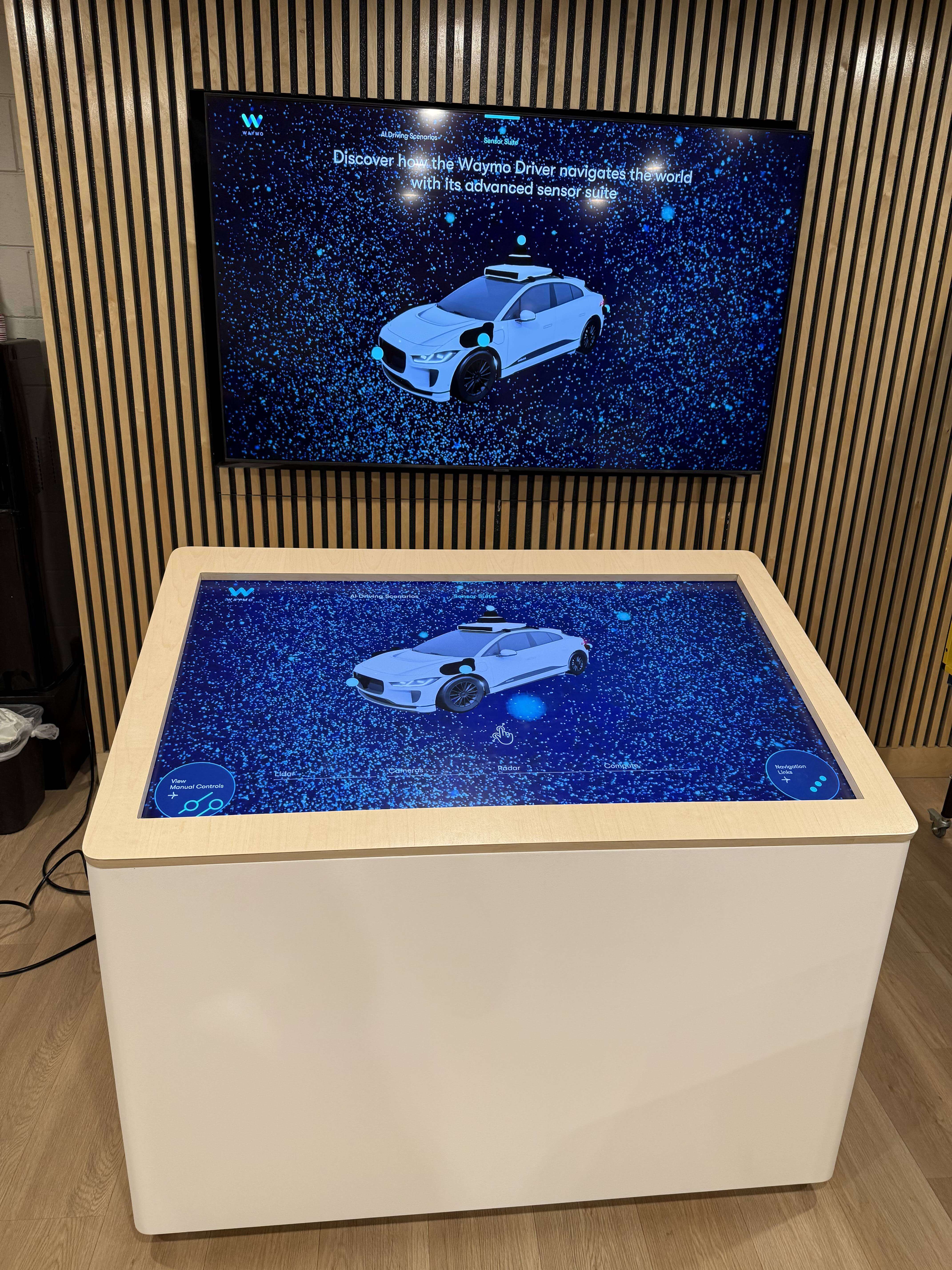
Visitors approach a large-format touchscreen kiosk where they're greeted with a stunning 3D rendering of a Waymo autonomous vehicle. The interface invites exploration through intuitive touch controls that feel both futuristic and familiar.
Users can rotate around the vehicle, zoom in on specific components, and select from multiple Waymo vehicle models to explore different configurations. When a guest taps on a sensor—whether it's a roof-mounted LiDAR unit, side-facing radar, or front camera—the system responds with particle effects that visualize how that sensor perceives the world. Short, informative videos explain how each sensor contributes to the vehicle's understanding of its environment and decision-making processes.
The experience also showcases real-world driving scenarios, allowing guests to toggle between different sensor views to see how LiDAR, radar, and cameras work independently and as an integrated system. This hands-on exploration demystifies autonomous driving technology, transforming abstract concepts into tangible understanding.
Key Features
- Interactive 3D Vehicle Models - Multiple Waymo vehicle configurations available to explore with smooth rotation, zoom, and inspection controls
- Sensor Deep-Dives - Selectable individual sensors (LiDAR, radar, cameras) with detailed explanations of function and purpose
- Particle Effect Visualization - Custom particle systems that simulate sensor data and perception fields in real-time
- Educational Video Integration - Embedded video content explaining autonomous driving decision-making and environmental interpretation
- Model Switching - Seamless transitions between different Waymo vehicle types
- External Monitor Support - Optimized for kiosk setup with external display configuration for trade show environments
Technology Stack
Engine: Unreal Engine
Language: C++ / Blueprints
3D Graphics: Real-time rendering, custom shaders for sensor visualization
User Interface: UMG (Unreal Motion Graphics) for touchscreen interaction
Video Integration: Media Framework for embedded educational content
Hardware: Touchscreen kiosk with external monitor output
Particle Systems: Niagara VFX for sensor data simulation
Technical Challenges & Solutions
Custom Sensor Interaction System
Challenge: Creating an intuitive interaction model that allowed users to select specific sensors on a 3D vehicle while maintaining visual clarity and performance on kiosk hardware.
Solution: Developed a custom raycast-based selection system with collision detection optimized for touch input. Implemented visual feedback states (hover, selected, active) with smooth transitions. Created a modular component architecture where each sensor is a self-contained actor with its own interaction logic, particle effects, and information display, ensuring scalability across different vehicle models.
Real-Time Particle Effect Performance
Challenge: Simulating complex sensor data visualization through particle effects that needed to run at 60fps on kiosk hardware while maintaining visual impact for large external monitors.
Solution: Leveraged Unreal's Niagara particle system with LOD (Level of Detail) optimization. Implemented dynamic particle count scaling based on sensor type and viewing distance. Used GPU-accelerated particle simulation and optimized material shaders to reduce draw calls while maintaining the visual quality needed to communicate sensor coverage areas and data streams.
Multi-Display Kiosk Configuration
Challenge: Supporting both touchscreen interaction on the primary kiosk display and mirrored/extended output to external monitors at various resolutions and aspect ratios across different trade show venues.
Solution: Built a flexible display management system within Unreal that detects connected displays and automatically configures output settings. Implemented resolution-independent UI scaling and created configuration profiles that event staff could quickly deploy for different hardware setups without requiring developer intervention.
Results & Impact
The Tech on the Go platform successfully cut through the noise of CES 2025, positioning Waymo as the definitive leader in autonomous vehicles through interactive education rather than speculative promises.
CES 2025 Metrics:
- 141,000+ Total CES attendees
- 8,700+ Unique visitors to Waymo exhibit
- ~65,000 Unique impressions
- 943,000+ In-person engagement moments
- 92% of visitors had net-neutral or positive response
- 38%+ of visitors engaged for more than 5 minutes (significantly above typical trade show engagement)
The platform proved that complex technical concepts could be made accessible through thoughtful interactive design, with over one-third of visitors spending substantial time exploring the technology in-depth.
Interactive 3D Waymo Vehicle Demo
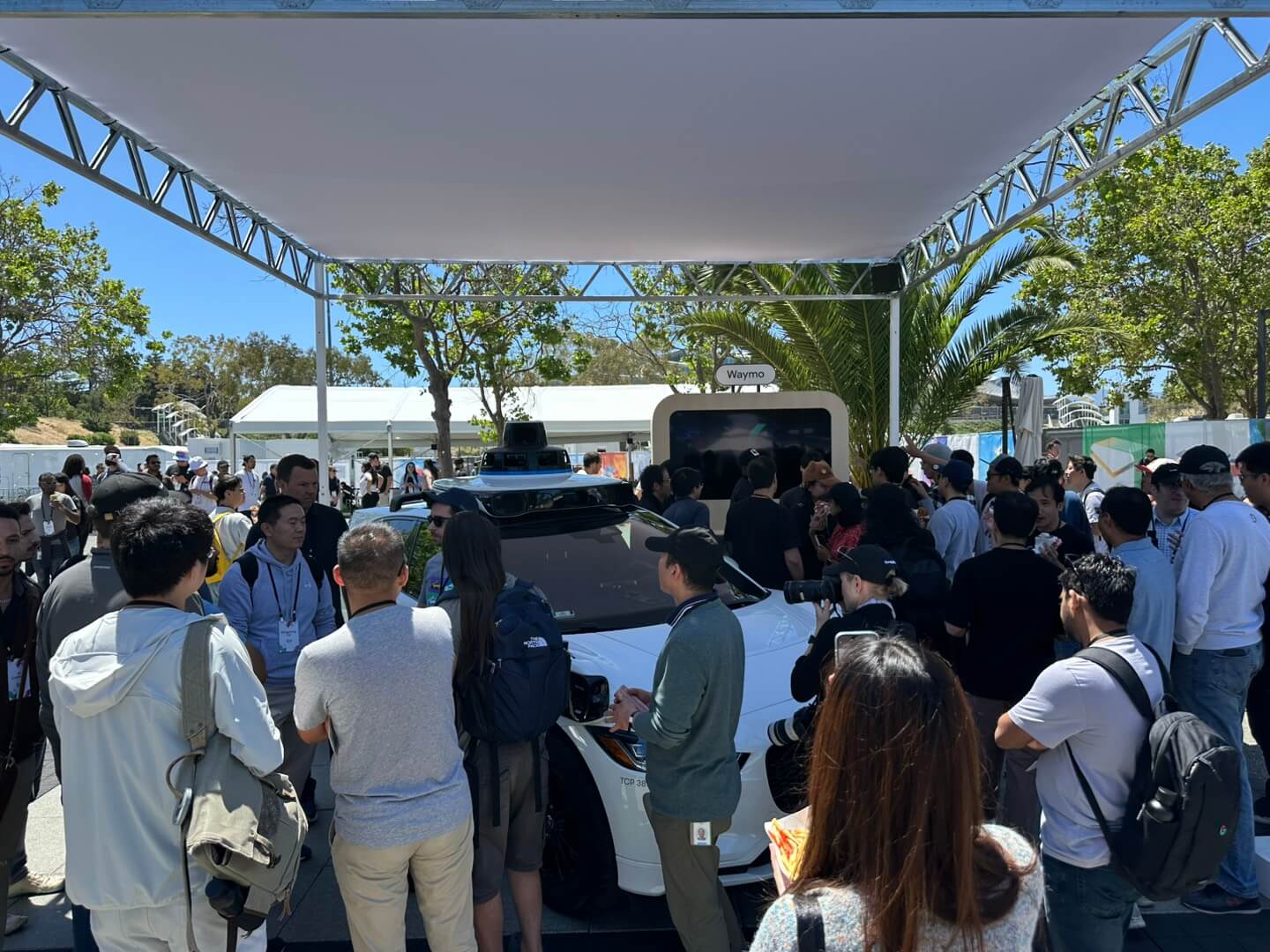
Additional Images
Additional Notes
Project Scope: Traveling kiosk installation designed for deployment at multiple trade shows and events beyond CES, with user manual documentation for setup and operation by event staff.
Technical Documentation: Created comprehensive user manual for non-technical event staff to handle setup, operation, and basic troubleshooting of the kiosk system.
Key Achievement: Successfully translated highly complex autonomous vehicle sensor technology into an intuitive, engaging experience that resonated with both technical and non-technical audiences, achieving exceptional engagement metrics.
Tags: unreal-engine interactive-3d automotive kiosk trade-show particle-effects touchscreen educational-tech waymo autonomous-vehicles